coconut pesto

Author: admin

  • Home Made Pizza Recipe (share)

    Home Made Pizza Recipe (share)

    Cheesy pepperoni and vegetable pizza fresh from the oven with green onions topping.
    Home Made Pizza

    Tired of waiting for your pizza to be delivered? Or pizza place closed? Then why not make your very own delicious pizza at home!? It’s easy!

    Ingredients:

    • 1 and 1/2 cup flour
    • 3/4 teaspoon yeast
    • 3/4 teaspoon sugar
    • 2/3 cup warm water (110 F or 43 C)
    • 1 tablespoon olive oil 
    • 1/2 teaspoon salt

    Directions

    It’s important to have the right warm water temperature as listed on ingredients so that yeast can “activate”. Else the dough will have trouble rising.

    Mix warm water, yeast, sugar and salt and stir a bit. Then add 1 cup flour at a time while mixing until all flour is mixed in. Eventually knead the dough until the dough is stretchable without tearing. It is easier to mix it in a dough mixer (machine) but by hand will also work with the benefit of exercising our hands (in the process of kneading the dough).

    Then make a round dough, put it in a greased bowl, cover it either with glad wrap or towel and let it sit for 30 mins. The dough should double in size by now. If planning to make the dough much later, put it in fridge and can be cooked the next day. The fridge makes the dough rise much slower, so perfect for delaying the rise until it is ready to be made.

    Once the dough has doubled in size, make a crust to cover a greased pizza plate. Either round or rectangle, it don’t matter.

    Filling

    Then for topping or filling, we can add literally anything. But not raw meat as it may not cook fully. To begin with coat the pizza crust with some kind of sauce. In this case Prego sauce is used. But you can use your own if not available. Spread presto sauce on the crust base. Then sprinkle some cheese. Then add precooked meat like salami, pepperoni, or even sliced sausages. Anything you wish such as mushrooms, pineapple, inions and diced tomatoes. And finally spread even more cheese.

    Baking

    Preheat oven to 400°F or 204°C. Place pizza to very bottom of oven for 5 minutes to make the crust cook faster and resulting in crispy crust (Can also cook the crust without toppings in oven for 5 min before adding the toppings). Then shift pizza to medium or top position for another 6 – 8 mins. Check the cheese. When it is melted enough, the pizza should be done!

  • Lamb Pot Roast Recipe

    Lamb Pot Roast Recipe

    Lamb pot roast
    Lamb pot roast all cooked.

    Making lamb pot roast is easy! It takes about 1/2 an hour altogether to cook.

    Pot Roast Lamb Recipe

    Chop up some lamb into desired pieces. Heat up pot, add a bit of oil as lamb is already oily then  add lamb into the pot. There should be a bit of water in the pot which comes along when lamb is washed. Since there is little water, occasionally check and stir as it could burn up real fast! (Then you will have burned lamb, not pot roasted lamb 😛 Your guests will be slightly amused. 😛  ) The idea here is to cook the lamb so when it is almost dry, add just a tiny bit of water so that it doesn’t burn. And keep stirring so the meat on the bottom does not burn and stick. Close lid and wait a few mins.

    When lamb is almost cooked, add some pounded garlic, chillies, salt, and paprika to taste. Paprika is just to make it look red. So add desired amount. Add some dark or light soy sauce to taste as well.

    Give it a few more minutes, it should be cooked. Obviously taste the lamb to ensure it is cooked. Once cooked, turn off stove and chop up some inions  add and even add some cilantro if you like. That’s it! Serve with a smile will make it even more delicious!

  • Curry Crab Recipe (suruwa kekra)

    Curry Crab Recipe (suruwa kekra)

    One delicious way to cook crab is to curry it. It can be either dry curry or souped curry. Souped curry is nice to eat with rice and such. This dish is also easy to make.

    Cooked Crab
    Cooked Crab

    Ingredients.

    • a few crabs
    • sliced onions
    • sliced tomatoes
    • garlic
    • chilly
    • cooking oil
    • salt
    • cilantro
    • curry powder
    • masala
    • indian spices (refer to picture below – name will be updated soon)

    Indian spices
    Indian spices

    Clean crabs and split or cut into pieces. See picture below. Heat up cooking oil in a pot and add indian spices (see pix – name coming soon),  onions, tomatoes, salt, garlic, chilly,  and stir so spices don’t burn. Keep stirring until the mixture is “almost” burnt. This is key so that the flavor in the spices is released by the heat. Add 2 cups of water to stop mixture from burning and add crabs.

    Crab in pieces already cleaned.
    Crab in pieces already cleaned.

    Let water boil and then add more water. Keep stirring once in a while. After 10 – 15 minutes it should be ready. Crabs don’t take long to cook.

    Add some cilantro and serve. Eat with rice, cassava, dalo, etc.

    Onions and Tomatoes
    Onions and Tomatoes

  • Rourou (taro leaves) recipe

    Rourou (taro leaves) recipe

    Taro Leaves
    Taro Leaves

    Taro is one of the favorite food in the pacific islands. The root itself is cooked and so are the leaves. The leaves is what we make rourou from and it’s very easy to make.

    Rourou recipe ingredients

    • young taro leaves (a medium bowl full should do)
    • coconut cream – either from fresh coconuts or canned
    • 1 chopped onion
    • 1 teaspoon chopped garlic
    • salt
    • canned meat (optional)
    • chilly (optional)
    • tomato (optional)

    Rourou with canned mutton
    Rourou with canned mutton

    Preparation

    Remove the stems of the taro leaves (cut with knife) so only leaves remain. Wash and cut thinly. Can also just tear the leaves as it’s added to the pot.

    Boil 2 cups of water and coconut cream. Add salt, garlic, onion, chilly, tomato and canned meat and finally add the taro leaves. Bring to boil for about 15 – 20 minutes with lid off. Keep stirring once in a while.

    Taro leaves contains harmless acidity and should be boiled for at least 10 minutes so that it does not itch the throat. Good taro leaves should feel soft. Taro leaves are high in vitamins as well.

    If there aren’t any taro leaves available, many type of vegetable leaves could be used like cabbage, spinach, etc.

    Spinach rourou - a good substitute for taro leaves is spinach!
    Spinach rourou – a good substitute for taro leaves is spinach!

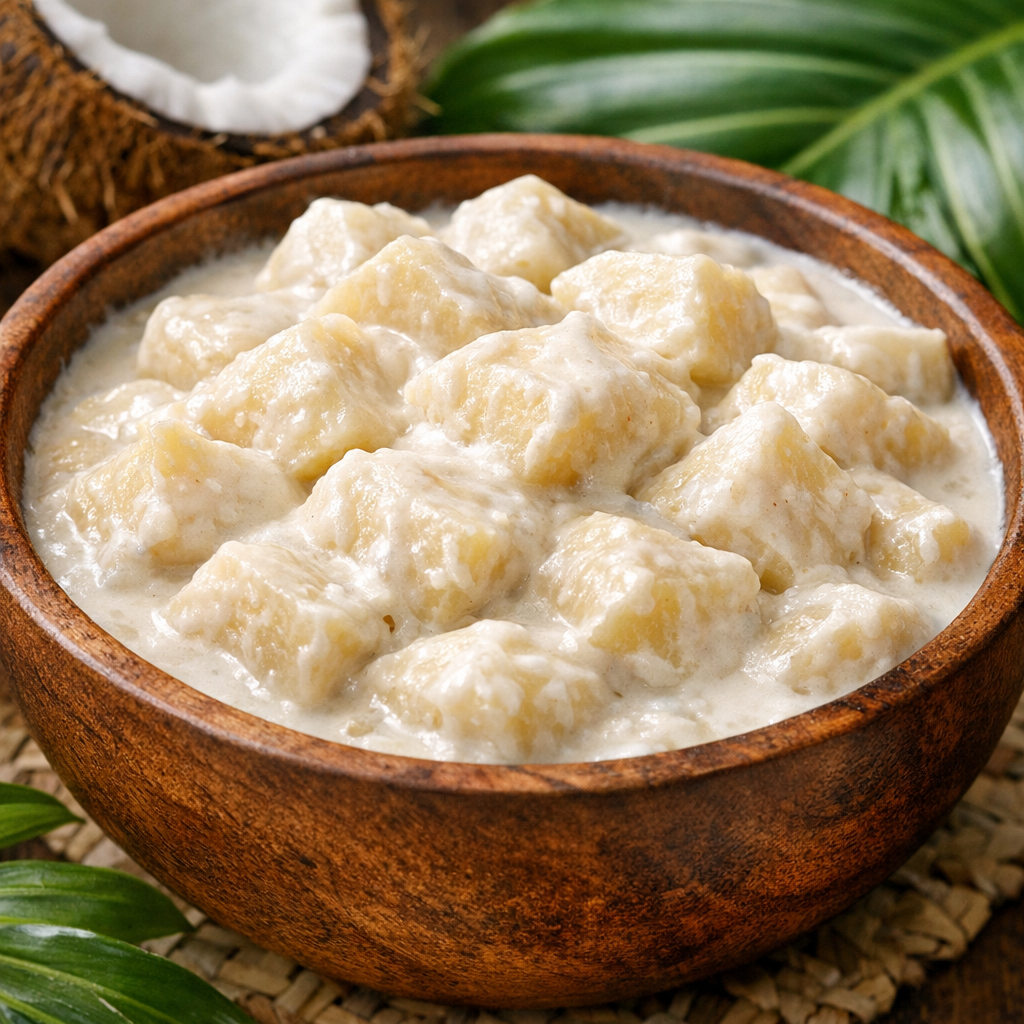
  • Lote (Cassava Desert) Recipe

    Lote (Cassava Desert) Recipe

    Lote Ingredients
    Lote Ingredients

    One of many favorite desserts and it is very easy to make!

    Lote Ingredients

    • 1/2 cup of sugar
    • 1 cup grated cassava
    • 3 cups water
    • 1 cup sliced banana
    • 1 cup diced pineapple
    • 1 cup coconut cream

    In a pot, bring water to  boil and add sugar and cassava (It is optional to add the coconut cream at this point, else it can be used later while serving). Mix well. Then after a about 4 – 5 minutes add the rest of the fruits. More water may need to be added if it becomes too thick. After 3 – 4 more minutes the dessert is ready. Let it cool and serve with a bit of coconut cream milk if it hasn’t been boiled before.

    Lote cooked (Cassava Desert).
    Lote cooked (Cassava Desert).


  • Palusami Recipe

    Palusami Recipe

    Palusami is a delicious dish from the Pacific Islands and has been around for many many years. And as such , it can be made in a variety of ways or methods. Usually, traditionally Palusami is prepared and cooked in the lovo (hot stone earth oven), but can also be cooked in a conventional oven or just a regular pot on the stove. But the recipe for preparing it is all the same. So long as it is cooked one way or another.

    Lovo fire burning
    Lovo making in progress. When stone is red or white hot, the left over firewood is removed, stones leveled flat and wrapped food is placed on top of the stone and finally buried and steam cooked for about 1.5 to 2 hours.

    Ingredients:

    • Some tinned meat (like tinned mutton or beef) if you plan to make a meat palusami else no meat and it becomes a vegetarian palusami
    • Some diced onions
    • Fresh Taro leaves (this is the main part and they must be whole taro leaves without it’s stem)
    • Diced tomatoes (optional)
    • Coconut cream, either freshly made or buy tin canned from the store
    • Salt
    • Chilly
    • Garlic
    • Ginger

    Palusami Recipe Preparation

    Prepare the taro leaves by removing the stem of the taro so only the leaves are left. Stack them up so they are easy gather a few at once.

    After preparing the taro leaves, prepare the palusami fillings.

    Mix in a big bowl the contents of canned meat, diced tomatoes, onions, some chilly, freshly pounded garlic, ginger and pour in the coconut cream. Mix well.

    In a big bowl pour the coconut cream in it with diced ionions, empty the tinned meat, add some salt to taste, chilly, garlic and a tad bit of lemon juice. Mix well. This is basically what will be put inside taro leave wrap.

    Making palusami
    Making in the making. On the left are taro leaves and on the right is the palusami fillings.

    Next gather up some taro leaves to make a bowl shape by stacking leaves together with big ones at the bottom. It should be shaped in a way that when the palusami fillings are poured into it, it won’t leak. Pour some palusami fillings about 1 cup into the prepared taro leaves and close the leaves together. Wrap the leaves into aluminium foil so it don’t fall apart.

    Keep wrapping until run out of taro leaves and fillings.

    Then if the lovo is ready, place palusami in lovo. This is the traditional method of making palusami.

    If making a lovo is not convenient then just place the wrapped palusami in a conventional oven and bake for about an hour.

    Also if the palusami isn’t going to be cooked in the lovo, then just cut up the taro leaves into small pieces in a baking tray and add in the palusami fillings. Mix and bake in oven for about an hour.

    Pealed taro being placed in lovo
    Pealed taro being placed in the lovo and other cooked food including palusami wrapped in foil.

    Or place in pot and cook on a regular stove in a pot. It comes out the same either way believe it or not! Although some will swear by the lovo method to be the tastiest but this is a subjective matter. Each to their own taste buds! 🙂

    Let us know how yours comes up and post comments and pictures below. 🙂

  • Soggy Biscuit or Bisikete Toni Recipe (share)

    Soggy Biscuit or Bisikete Toni Recipe (share)

    We all have that day where no one wants to cook, or there isn’t anything else for breakfast that can be served “fast” as we all are running late. Or just pure laziness kicks in decided to stay. And the bright idea flashes before our eyes!  “Biscuit in tea?”

    Buttered soaked breakfast crackers
    Buttered soaked breakfast crackers

    That’s right, one of the quickest breakfast and yet easy and tasty to eat is the soggy biscuit as some call it and in Fijian it is called “bisikete toni” which translated to soaked biscuit. It is still not know who came up with this idea, but it seems everyone else knows it.

    This recipe is being highlighted as it has become a culture in Fiji. Culture by definition of pretty much majority of society are familiar with.

    And yet it’s very simple, not sure it qualifies to be a recipe but never the less, the information is here for others who may not be aware of. Or want to find out something unique to Fiji.

    Here is the recipe for Soggy Biscuit or Bisikete Toni. The recipe is in pictures so its very easy to follow along and everyone will not be lost following it. :))))

    1. Gather up some breakfast crackers.

    Breakfast Crackers
    Breakfast Crackers


    2. Prepare a cup of tea.

    A cup of tea
    A cup of tea where it has enough room to soak the crackers

    3. Soak breakfast crackers.

    Soaking breakfast crackers or buiscuit
    Soaking breakfast crackers or buiscuit

    4. Take out breakfast cracker.

    Soaked breakfast crackers
    Soaked breakfast crackers

    5. Spread butter on breakfast crackers.

    Buttered soaked breakfast crackers
    Buttered soaked breakfast crackers


    Eat away!

  • Purini or Fijian Coconut Steam Pudding Recipe

    Purini or Fijian Coconut Steam Pudding Recipe

    Purini or Fijian coconut steam pudding is one of the oldest pudding dish around in Fiji and it is absolutely delicious! I’ve even seen it being cooked / steamed in natural hot spring water!

    Purini Recipe Ingredients:

    • 1 – 2 cup or tin coconut cream
    • 2 cups of brown sugar, or 3 cups white sugar as white sugar is not that sweet.
    • 3 cups self raising flower
    • 2 table spoon baking soda
    • 2 eggs
    • 4 table spoon margarine butter
    • 2 – 3 medium ripe bananas (mashed)

    Purini Instructions:

    1. In a medium heat saucepan, melt the sugar and butter, ensuring the sugar doesn’t burn.
    2. Once melted, add the eggs and mix well.
    3. Gradually add the coconut cream, pouring it slowly to avoid splashing. Stir continuously until the sugar is fully dissolved, then set aside to cool.
    4. In a separate mixing bowl, combine all the dry ingredients and mix thoroughly.
    5. Slowly incorporate the cooled sugar mixture into the dry ingredients, adding a little at a time, until the batter reaches a consistency similar to pancake batter.
    6. Add the mashed banana and stir until well combined.
    7. Pour the purini batter into a steaming pot and steam for approximately one and a half hours.
    8. To check if it’s done, insert a fork into the purini. If it comes out clean, the purini is ready.
    9. Optional: Prepare some custard and drizzle it over the sliced purini for a dessert-style treat. Alternatively, simply slice and serve with tea or juice.

    Did you know?

    Purini are also known as Puteni, Puligi, and Burnt Sugar pudding according to wikipedia at least. It’s historical existence isn’t known but we can bet a dollar that it was introduced by the British.

    Purini cooked in hot spring water
    Purini cooked in hot spring water
    A pot of food being cooked at the Savusavu Hot Spring.
    A pot of food being cooked at the Savusavu Hot Spring.
  • Baked Grated Cassava Cake Recipe (tavioka yaca)

    Baked Grated Cassava Cake Recipe (tavioka yaca)

    picture of cassava cake with raisins

    One of the most delicious item to eat at least in Fiji is baked grated cassava. Some call it cassava cake and we call it in Fijian “tavioka yaca”, means grated cassava.

    Ingredients

    1. Grated cassava. Can buy ready grated cassava in packets, frozen or buy fresh cassava, peal it, grade it and your all set.
    2. 1/2 cup sugar in general but add amount to taste
    3. 2 eggs (optional)
    4. 1/3 cup milk
    5. Vanilla (optional)
    6. Raisins (optional)

    Directions

    Mix grated cassava in a bowl along with eggs and add 1/2 cup sugar, hint of vanilla and mix well. After thoroughly mixing taste the sugar and add more sugar according to your liking. Add some raisins if you like as well.

    Then in a bowl, pour grated cassava and mix melted sugar thoroughly. Add some vanilla for taste.

    Put in a greased baking tray and bake for 1 hour at 350 degrees Fahrenheit. The top should start getting golden brown. Stick a folk into it to see if it done when something sticks onto the folk.

  • Yummy Food Photo Gallery

    Yummy Food Photo Gallery